
How to Find Affordable Custom Wedding Suits Online
Last Updated: October 25, 2026
Quick Summary
Affordable custom wedding suits online are built around your measurements, so you pay for fit rather than a designer label. Build your budget from the total cost, including fabric tier, construction, customization, shipping, rush fees and local alterations, not the advertised starting price. If you have two or more formal events in the next few years, a custom purchase can offer better cost per wear.
Renting looks cheaper on day one but adds fees for every groomsman and every event.
Ask each provider for a written quote listing every cost line before paying a deposit.
Buy if you will wear a suit more than twice in the next few years; otherwise rent.
Measure twice with someone helping, keeping the tape snug but not tight.
Lock one fabric code, lapel style and order window so the whole party matches.
Table of Contents
What Affordable Custom Wedding Suits Online Actually Cost
Itemized Cost Breakdown: Custom vs. Rental
The Total-Cost Worksheet Competitors Skip
When the Total Actually Favors Buying
Should You Buy or Rent a Wedding Suit?
Your Online Suit Measurement Guide for a Reliable Fit
Fabric and Style Choices That Suit Your Venue and Season
Custom Suits for Groomsmen: Coordinating a Scattered Wedding Party
Group Ordering Mechanics That Keep Everyone Consistent
Fitting Different Body Types Without Breaking the Look
Managing Different Budgets Across the Party
A Practical Party Timeline
Wedding Suit Alterations, Remakes, and Fit Guarantees
Book Your Mobile Fitting or Showroom Consultation
Frequently Asked Questions
What Affordable Custom Wedding Suits Online Actually Cost
Affordable custom wedding suits online start with a simple truth: you are paying for fit, not for a designer name on a label.
The trick is understanding what drives the number up or down.
Fabric tier: entry-level wool blends cost far less than premium Italian cloth.
Construction: full canvas costs more than fused or half-canvas.
Customization depth: a standard pattern with tweaks is cheaper than a fully bespoke cut.
Shipping and rush fees: ordering early avoids expedited charges.
We recommend building a budget from the total, not the sticker. As the Federal Trade Commission's consumer guidance on online purchases notes, knowing your full costs and return rights before you buy protects you if something goes wrong.
Itemized Cost Breakdown: Custom vs. Rental
Renting looks cheaper on day one. It rarely is by the time you add everything up. A rental typically bundles the jacket, trousers, shirt, and accessories for a flat fee, but you pay again for every groomsman and every event.
Here is how the two compare across the costs that actually matter:
Cost Factor | Custom Purchase | Rental |
Base garment | One-time, yours to keep | Per-event fee, returned after |
Fit adjustments | Built into the order | Limited, often extra |
Alterations | Minor tweaks only | Sometimes charged separately |
Shipping | One delivery | Multiple shipments for a party |
Reuse | Wears for years | None |
Damage risk | Yours to maintain | Fees for damage or loss |
The custom route can offer value if you attend multiple formal events. The rental route can be suitable if you truly need a suit once and never again.
The Total-Cost Worksheet Competitors Skip
Most guides quote a starting price and stop. That number is not what you pay. Use this worksheet to compare any online custom suit offer against a rental on equal terms.
Line Item | What to Record | Why It Changes the Total |
Base suit price | Jacket and trousers as configured | The advertised starting price usually excludes upgrades |
Fabric upgrade | Cloth tier selected | Mid-tier wool blends commonly add a meaningful percentage over entry cloth |
Customization add-ons | Linings, monogram, extra pockets, contrast stitching | Small add-ons accumulate fast |
Shipping | Standard delivery to one address | Party orders multiply this line |
Rush fee | Expedited production or delivery | Avoidable with early ordering |
Local alterations | Sleeve, waist, hem tweaks after delivery | Budget a realistic allowance even on custom suits |
Accessories | Shirt, tie, shoes, cufflinks | Rentals often bundle these; custom orders usually do not |
Care and storage | Cleaning, garment bag, hanger | A purchase you keep needs upkeep |
Return or remake cost | Any fee if fit misses | Read the fit guarantee before ordering |
Two patterns matter. First, a custom suit's total is front-loaded: you pay once, then wear it for years. Second, the gap between advertised and actual cost is widest on rush orders and accessory add-ons, so price those explicitly rather than assuming they are included.
Pro Tip Ask each provider for a written quote that lists every line above before you pay a deposit. A quote you can compare side by side is worth more than any starting price.
When the Total Actually Favors Buying
Run the worksheet for your real calendar. If you have two or more formal events in the next few years, a custom purchase can offer better cost per wear. If your wedding is the only event and the date is close, a rental or stock purchase can keep the total lower. The honest answer depends on the worksheet, not the headline.
Should You Buy or Rent a Wedding Suit?
Buy if you will wear a suit more than twice in the next few years. Rent if this is genuinely a one-time event and budget is the only constraint.
A custom wedding suit can be a valuable investment for multiple formal occasions. A rental is typically for a single event.
Renting suits one real advantage: speed. If you are weighing the pitfalls of rentals, our guide on avoiding ill-fitting wedding rental suits walks through the common failures and how to dodge them.
Your Online Suit Measurement Guide for a Reliable Fit
Accurate measurements are the whole game with online ordering. A custom wedding suit only fits if the numbers you send are correct, so treat measuring as a task, not an afterthought.

Follow this checklist:
Chest: measure around the fullest part, arms relaxed at your sides.
Shoulders: from the edge of one shoulder bone to the other.
Sleeve: from shoulder seam to wrist bone, arm slightly bent.
Waist: around your natural waistline, not your hips.
A common mistake is measuring over bulky clothing or guessing the inseam. The National Institute of Standards and Technology maintains measurement standards that underline why consistency matters in sizing.
Fabric and Style Choices That Suit Your Venue and Season
Fabric and venue should decide your suit, not the other way around.
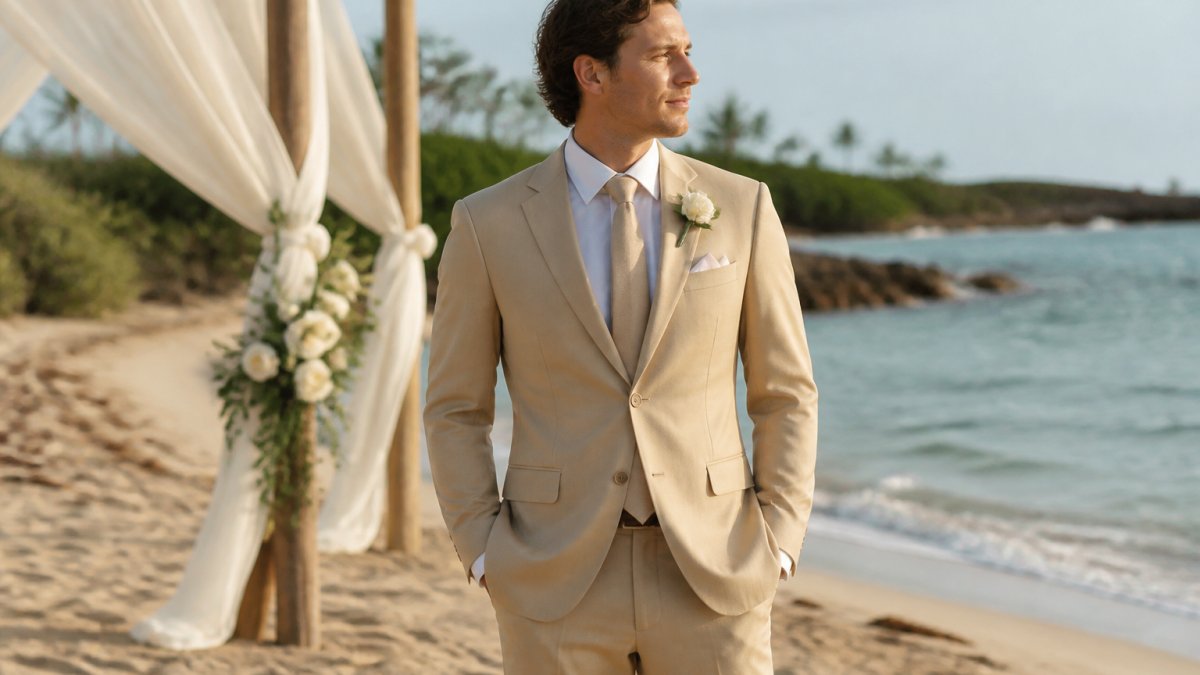
For warm-weather or outdoor venues, lighter wool and breathable blends keep you comfortable. For fall and winter, mid-weight wool holds its shape and looks sharp in photos.
Style details matter too. Peak lapels read more formal, notch lapels more versatile. A two-button jacket is the safe default. Pick a shirt and tie that complement rather than compete.
Custom Suits for Groomsmen: Coordinating a Scattered Wedding Party
Coordinating groomsmen across states is the hardest part of wedding attire, and it is where most plans break. The fix is a single process everyone follows, not a dozen separate orders.
Assign a point person to track each groomsman's progress. Share a simple timeline: measure by month six, order by month four, deliver by month two, final fittings by month one.
If your party is spread out, rental packages can simplify logistics since everyone gets the same suit shipped to their door. Our guide to wedding suit rental packages for groomsmen covers how to run that coordination without chaos.
Group Ordering Mechanics That Keep Everyone Consistent
Matching a wedding party is not about identical bodies; it is about identical cloth and trim. Lock these variables before anyone orders:
One fabric code and color name. Ask the provider for the exact mill and fabric number, not just "navy." Different dye lots can read as different shades in photos.
One lapel and pocket style. Peak versus notch, flap versus jetted, and vent style should be identical across the party.
One button stance and jacket length rule. Set a standard, then adjust only for height.
One shirt and tie specification. Color, collar, and tie width should match even if fits differ.
A common pattern is to let each groomsman choose his own fit details while the cloth and trim stay fixed. That keeps the group photo cohesive without forcing every body into the same cut.
Fitting Different Body Types Without Breaking the Look
Groomsmen rarely share a build. The goal is a consistent silhouette, not identical measurements. Use these adjustments as a starting framework:
Body Variation | Fit Adjustment | What Stays Fixed |
Taller groomsman | Slightly longer jacket and sleeve | Cloth, lapel, buttons |
Broader chest or shoulders | More room through the chest, tapered waist | Cloth, lapel, buttons |
Shorter frame | Shorter jacket, higher button stance | Cloth, lapel, buttons |
Larger waist | Higher-rise trousers, side adjusters | Cloth, lapel, buttons |
Athletic build | Trim waist suppression, room in seat | Cloth, lapel, buttons |
Have each groomsman submit measurements through the same form and, where offered, a remote fit review. A provider that flags outliers before production can help avoid a remake scramble.
Managing Different Budgets Across the Party
Not every groomsman can spend the same amount, and pretending otherwise causes friction. Handle it openly:
Set a ceiling, not a target. Tell the party the maximum total, including shipping and alterations.
Offer a tiered option. Many providers let the group keep the same cloth while varying construction or add-ons.
Decide who pays for what. Grooms sometimes cover ties, shoes, or alterations; state it in writing.
Use one order and one invoice per person. This avoids one groomsman fronting the whole party's cost.
Build a contingency line. A small per-person buffer covers a rush fee or a local alteration.
Watch Out Do not let groomsmen order from different providers to save a few dollars each. Mismatched cloth and trim can be a visible issue in wedding photos, and it can be difficult to fix after the fact.
A Practical Party Timeline
Work backward from the wedding date and put every step on a shared calendar:
Six months out: choose cloth, trim, and provider; collect measurements.
Four months out: place all orders in the same window; confirm shipping addresses.
Two months out: confirm delivery tracking for each groomsman.
One month out: local fittings and minor alterations.
Two weeks out: final check of shirts, ties, shoes, and accessories.
A party that follows one process, one cloth specification, and one timeline can help avoid common issues with group attire, such as mismatched fabric and last-minute fit fixes.
Wedding Suit Alterations, Remakes, and Fit Guarantees
Alterations are normal; remakes should be rare. Even a well-made custom wedding suit often needs minor tweaks once it arrives, like shortening a sleeve or taking in the waist.
A key aspect of a good provider is how they handle situations when the fit is wrong.
Watch out: ordering without confirming the remake and return terms leaves you exposed if the suit arrives off.
Book Your Mobile Fitting or Showroom Consultation
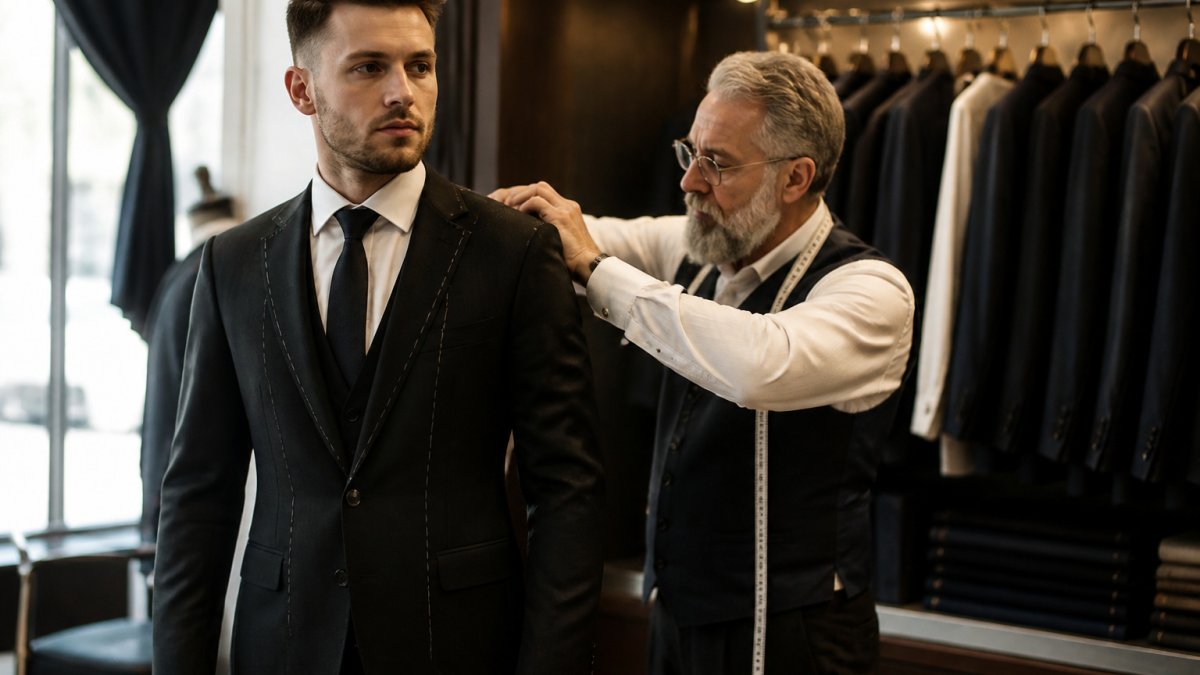
The fastest way to get a reliable fit is to have a professional take the measurements. At Bridal Knight, our mobile fitting room brings a trained fitter to your home or venue, and our showroom offers a full consultation for grooms who prefer to come in.
Ready to move from research to action? Book online to schedule your fitting, or book a studio fitting if you would rather visit in person. Before you decide, check our showroom location for visit details.
Frequently Asked Questions
How much do affordable custom wedding suits online usually cost?
Pricing depends on fabric, customization level, and quantity. Custom wedding suits can be a premium option compared to basic rentals. Bridal Knight does not publish fixed prices because each order varies by cloth selection, design details, and delivery timeline. Request a quote from Bridal Knight's website for current pricing, and compare that total against rental fees for you and your groomsmen before deciding.
Is it cheaper to buy or rent a wedding suit?
Renting usually costs less upfront for a single event, but buying a custom wedding suit gives you a garment you keep and wear again. If you factor in rental fees for the groom plus groomsmen, alterations, and shipping, buying can offer good value over multiple events. Compare itemized totals rather than headline prices, and ask about fit guarantees and remake policies before you commit.
How far in advance should you order a custom wedding suit online?
Order at least 8 to 12 weeks before the wedding day to allow time for measurement, production, shipping, and wedding suit alterations. If your groomsmen are spread across different locations, add two to three weeks for coordinating remote fittings and deliveries. Last-minute needs can sometimes be covered by stock inventory rentals, but custom orders need a longer runway.
Can groomsmen wear different suits that still look coordinated?
Yes. Custom suits for groomsmen can vary in fit while sharing the same fabric, color, and lapel style so the group looks unified. Give each groomsman the same cloth selection and design details, then let measurements handle individual fit. This approach works well for wedding parties in different states because each person orders to their own measurements while the overall look stays consistent.
Finding a suit that fits on the day should not depend on luck or a rushed rental. Bridal Knight combines full and semi-custom purchase options, an exclusive mobile fitting room, and on-site alterations so your suit is right before the ceremony starts. Get started with Bridal Knight and walk into your wedding in a suit built for you.
Set up an in store appointment!
Add bridalknight.com as a preferred source on Google →

Comments